
Feature showcase
Home and action workflows
Each Paperless document can have one Action Case with a title, summary, priority, due date, assignee, and top-level state. A case may contain up to 100 steps for compound work such as reviewing a renewal, comparing an offer, replying, and storing the confirmation. Solo workspaces upgrade to family households when another member is added.
Household members are managed profiles for assignment, permissions, and Telegram; they are not separate Tagvico web accounts. The local admin remains the web console owner in v3.
Tagvico mirrors its case ID, state, next due date, assignee, and tagvico/action tag to Paperless. It preserves unrelated tags and custom fields. The complete checklist and audit trail remain in Tagvico.
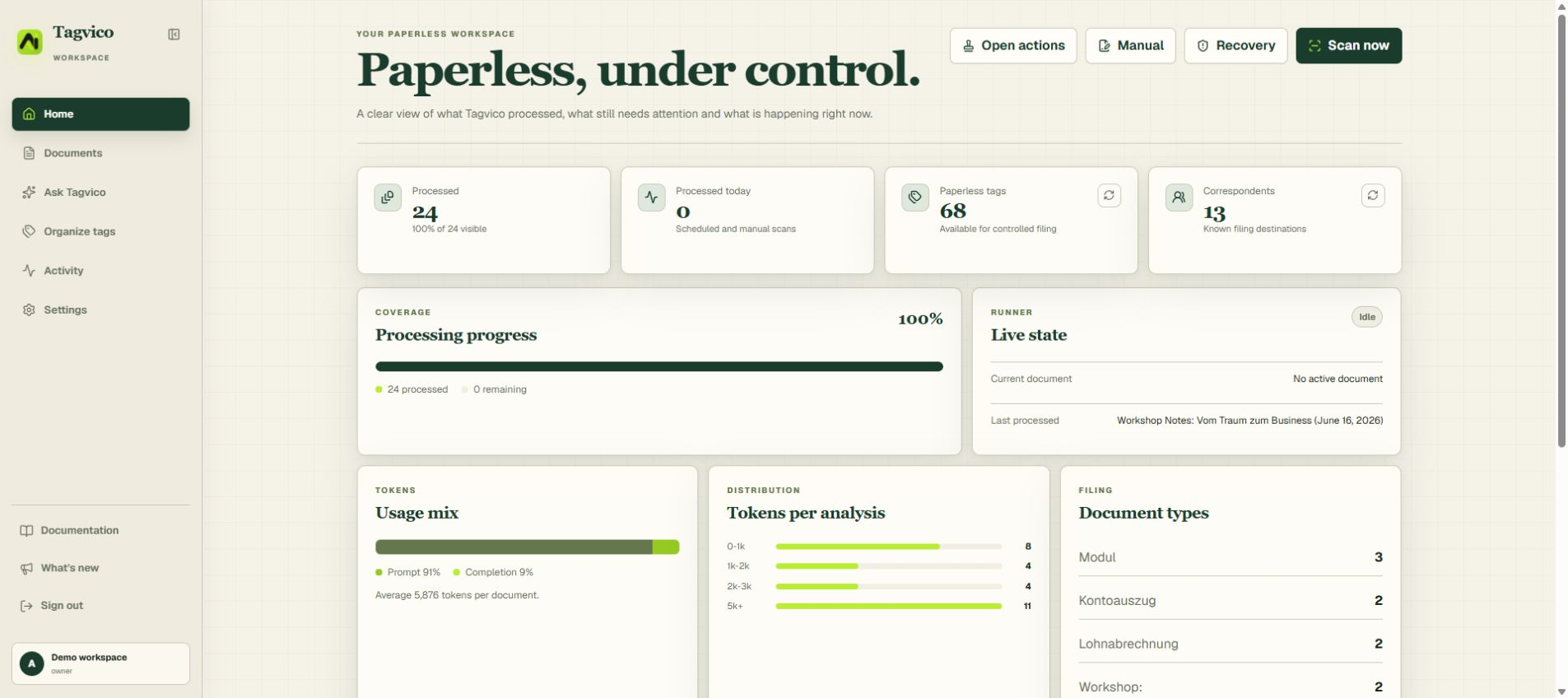
This v3.2 capture comes from the representative release installation. It uses generic document metadata and synthetic workspace labels. It exposes no document contents, real account identifiers, credentials, or private endpoints.
Household Companion and approvals
The Companion can count, search and read permitted Paperless documents, list and inspect tags, list current actions, and prepare document, tag or Action Case changes. The Tagvico harness owns the session, narrow tool catalog, permissions, transcript, and approval records; the selected model never receives shell or filesystem access.
Read tools run immediately. Write tools only create a durable proposal. An owner or adult must approve it before the deterministic executor changes Tagvico or Paperless. This includes creating, renaming, recoloring and deleting tags as well as changing document metadata. The web chat uses AI SDK v6 streams and AI Elements. Paperless research is intent-aware: a greeting stays a normal conversation, library totals, including doc://countdocuments, use an exact count, and document content is read only when the question requires it. Internal tool markers are never shown as document citations. Each research card can reveal the safe search term, matching document IDs, titles, dates, and result count without exposing OCR. The right-hand research trail remains visible while tools run and groups safe research evidence with any pending approvals. Conversations can be created, searched, renamed, switched, and deleted from the chat workspace. The composer model picker groups live models inside collapsible configured providers, shows each provider identity, and offers only the reasoning efforts advertised by the selected model.
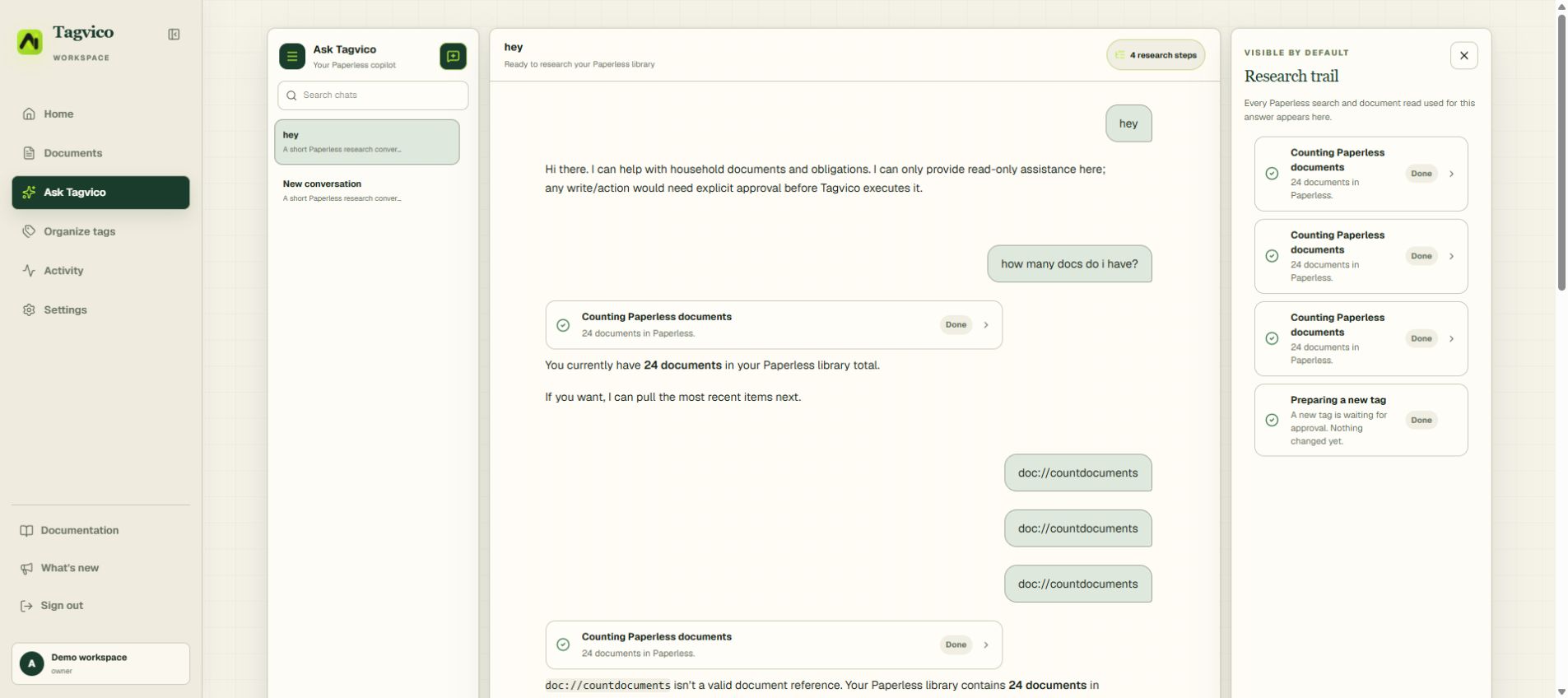
The capture uses generic count queries and synthetic workspace labels to show the research trail. No document contents, real account identifiers, credentials, or provider payloads are visible.
Operations at a glance
The dashboard shows processing progress, runner state, Paperless vocabulary counts, recent activity, and token/cost-efficiency signals. Scan now starts an on-demand pass without waiting for the schedule and reports how many documents were eligible, applied, staged, skipped, or failed. Trigger tags are optional: with no trigger tags, every new unprocessed document is eligible.
Home, Documents, Ask Tagvico, Organize tags, Activity, and Settings stay inside one React application shell. Recovery, Manual processing, the Action Center, and the conditional Review queue remain available from the workflows that need them instead of competing as unexplained primary tabs. They share the same fixed, collapsible navigation, Paper & Pine design tokens, responsive tables, dialogs, high-contrast tags and controls, and inline feedback. Page-shaped skeletons preserve the expected Home, Documents and Activity layout while their live data is loading. Provider and model catalogs use the same pattern instead of replacing the interface with loading text. The former EJS interfaces for user-facing workflows are no longer part of the visible application.
Controlled tagging
Choose whether the model may create open-ended tags or must stay within a controlled vocabulary. Tag groups make a larger Paperless tag catalog easier to manage, and a per-document maximum prevents noisy assignments. Four is the default hard ceiling in both modes. The shared provider prompt asks for the smallest useful set and avoids repeating language, correspondent, or document type as tags.
Review-first tag unification
The dedicated Organize tags workspace loads the current Paperless vocabulary and lets one configured, live-discovered model propose likely duplicates. Suggestions are grouped visually as several source tags becoming one canonical target, while every source remains independently reviewable. The model only plans and explains; it cannot write to Paperless. Every proposed merge is approved or rejected separately. Approved work runs as two explicit, idempotent phases: move document references to the chosen target, verify the result, then delete the now-unused source tag.
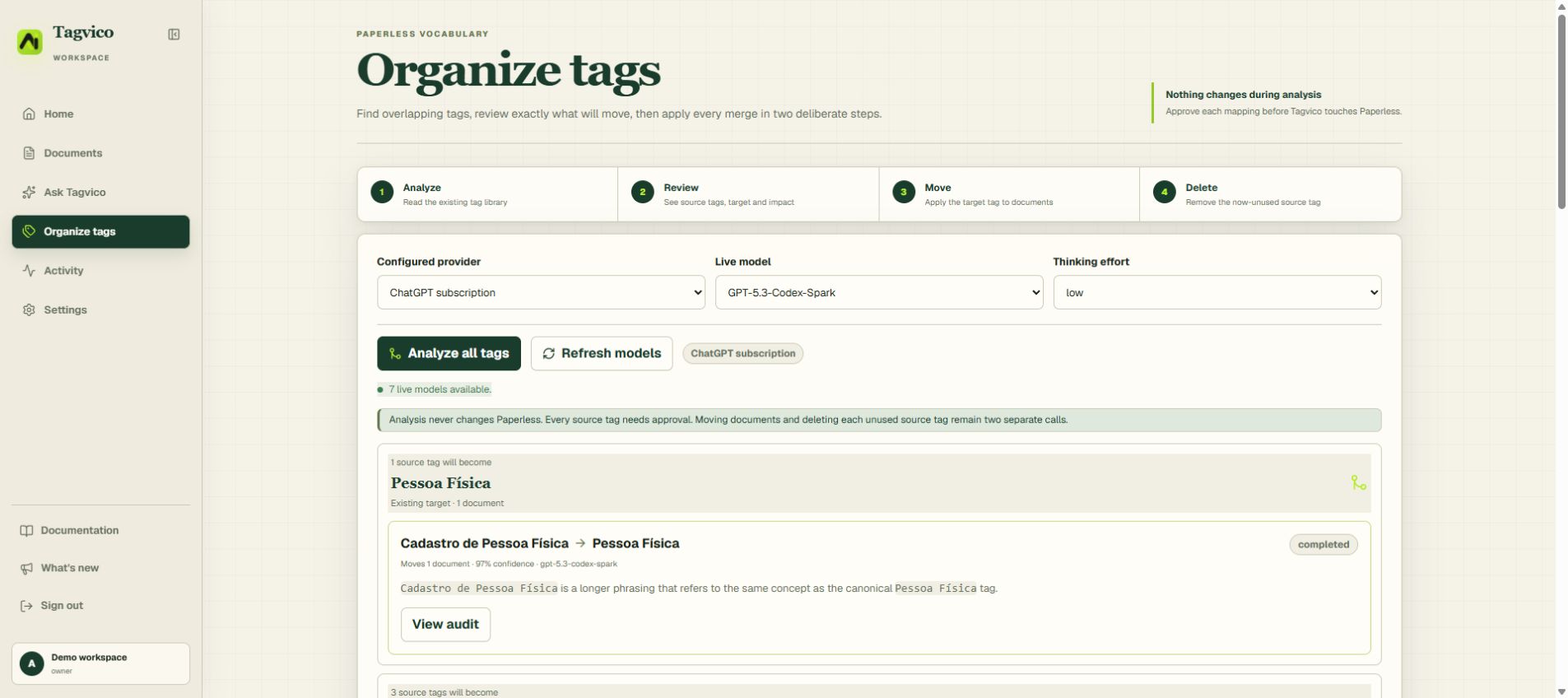
The representative capture uses generic duplicate tags and synthetic workspace labels. It contains no document content, real account identifiers, credentials, or endpoints.
Prompt control
The maintained general prompt works across providers. Custom filing prompt adds archive-specific terminology and preferences without replacing Tagvico's contracts. Advanced system prompt can replace the general role instructions, while prompt-injection protection, minimal-tagging rules and the structured response contract remain mandatory.
Review-first filing
In Review first mode, durable suggestions wait for approval. Inspect the metadata diff, apply it, reject it, or leave it queued. Switching to Automatic mode does not discard already queued suggestions.
In Automatic mode, Tagvico validates and writes enabled fields directly to Paperless. Both modes support titles, tags, correspondents, document types, dates, languages, custom fields, and optional owner assignment.
History, restoration, and retry control
Every processing run records assigned metadata, field-level before/after changes, custom fields, token usage, event source, and the original snapshot. Single and bulk rescans use the current provider settings and deliberately bypass the normal trigger-tag filter. Rescanning never deletes the audit trail or the first restore snapshot.
Restore original replaces title, tags, correspondent, document type, date, language, custom fields, and owner with the first state Tagvico captured. Use Validate history to preview records whose Paperless documents no longer exist, then clean up only those orphaned local records.
AI and OCR provider failures are attempted up to three times before moving into Permanently failed. Resetting a failed document makes it eligible again. Documents that must never be processed can instead be moved to the permanent Ignored documents list with an optional reason. Un-ignoring one explicitly queues a filter-bypassing rescan. Failed and Ignored counts remain visible in the sidebar.
OCR rescue
Documents with insufficient OCR can enter a durable rescue queue. Configure Mistral OCR, an OpenAI-compatible vision endpoint, or Ollama vision. Local PDF OCR limits rendered pages with OCR_MAX_PAGES; interrupted work returns to the pending queue after restart. OCR retries use the same bounded three-attempt discipline as document classification and cannot block the main scan queue forever.
In-product changelog
What’s new in the sidebar opens the release notes bundled with the running instance. The top entry is the prepared v3.2.0 changelog, followed by the complete v3.1 history. It stays marked as unreleased until the release image and tag are actually published.
Subscription-backed model access
The optional ChatGPT provider uses the bundled official Codex runtime for inference and the stable codex login --device-auth flow. Its model picker is fed by the signed-in account's live model/list response, including the runtime default and each model's supported reasoning efforts. Curated names are never presented as account availability. GitHub Copilot continues to use the official Copilot SDK.
Unified setup and settings
Setup and authenticated Settings now use the same React field, provider, and validation components. Settings are divided into Paperless, AI models, Automation, Tag library, Household, Security & privacy, and Diagnostics. The desktop navigation is fixed and collapsible; narrow screens use horizontal, scrollable navigation without a second legacy UI.
Provider configuration is generated from the central provider registry. The model picker supports runtime discovery, search, provider grouping, local favorites, capability badges, and keyboard-native controls.
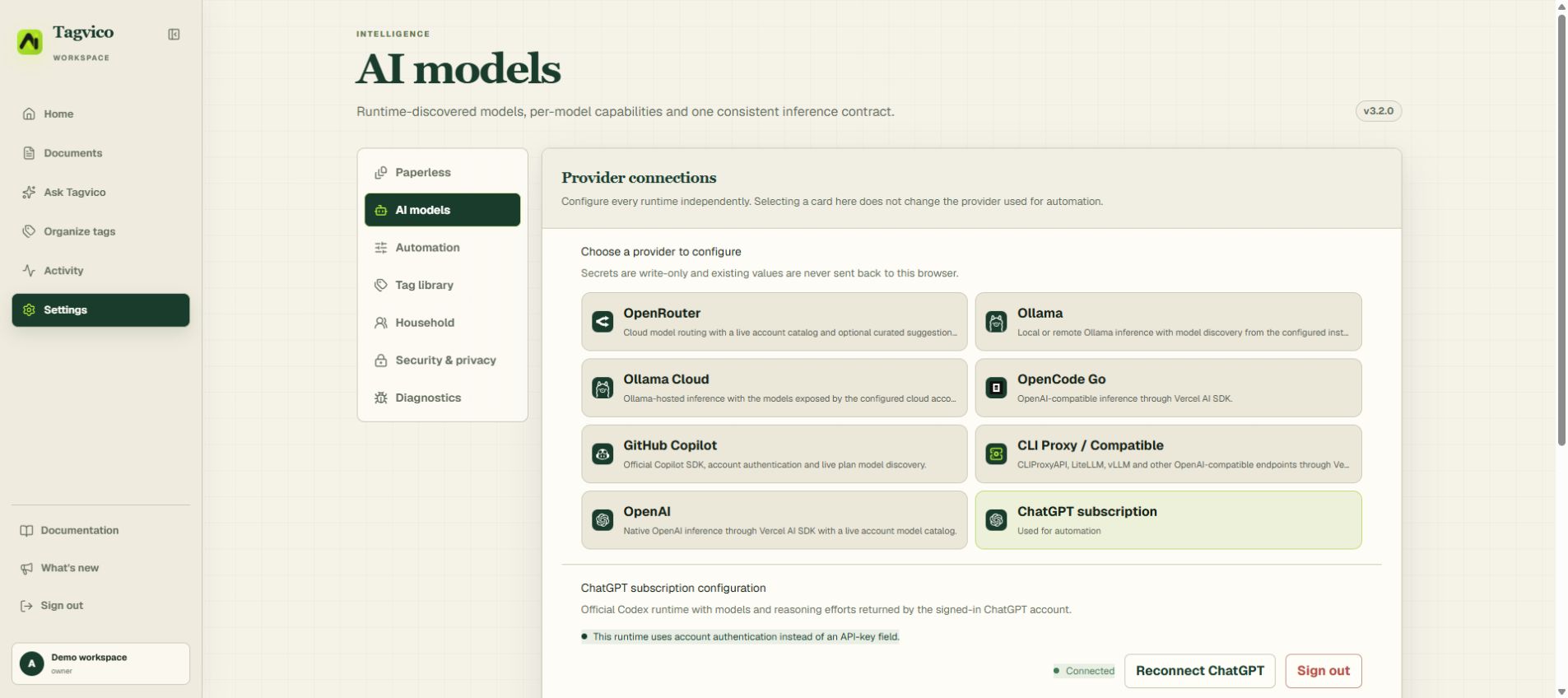
This capture shows provider names and product copy only. No API key, account identifier, private endpoint, or signed-in profile is exposed.
The Ask Tagvico composer uses the same runtime catalog, but includes only configured providers whose live discovery succeeded. It defaults to the document-automation model and persists a validated per-session override. Redacted activity cards make Paperless search, document reading, action lookup, proposal preparation, and tool errors visible without exposing OCR, tokens, or raw provider payloads.
Optional Telegram family interface
An opt-in long-polling bot lets allowlisted people search the archive in natural language, ask follow-up questions, download cited originals, and send a PDF or photo into Paperless. Each Telegram ID maps to its own Paperless API token; unknown users and group chats are ignored, and Paperless enforces every search, download, upload, and metadata permission.
Conversation history for the legacy cited-search flow is bounded and held in memory only. /clear removes one person's history, and a restart removes all histories. Uploads wait for the Paperless consumption task, link the existing document when Paperless reports a duplicate, and can optionally run Tagvico metadata classification. Automatic metadata for bot uploads is a separate explicit opt-in because it bypasses the web review queue.
When a Telegram allowlist entry also contains its Tagvico householdId and memberId, /actions lists open cases and explicit action requests can create approve/reject cards. Approval uses the same executor and audit trail as web. Action Center linking is accepted only when the Telegram entry points at the same Paperless instance as the main Tagvico configuration.
Optional anonymous installation analytics
Installation analytics are off by default. Administrators can preview the complete outbound heartbeat in Settings before opting in. Rotating daily and monthly identifiers support active-installation counts without creating a permanent installation profile; document content, metadata, URLs, identities, keys, exact counts, and errors are never included. See Privacy and security for the complete field list and retention design.