
Feature showcase
Operations at a glance
The dashboard shows processing progress, runner state, Paperless vocabulary counts, recent activity, and token/cost-efficiency signals. Scan now starts an on-demand pass without waiting for the schedule.
Controlled tagging
Choose whether the model may create open-ended tags or must stay within a controlled vocabulary. Tag groups make a larger Paperless tag catalog easier to manage, and a per-document maximum prevents noisy assignments.
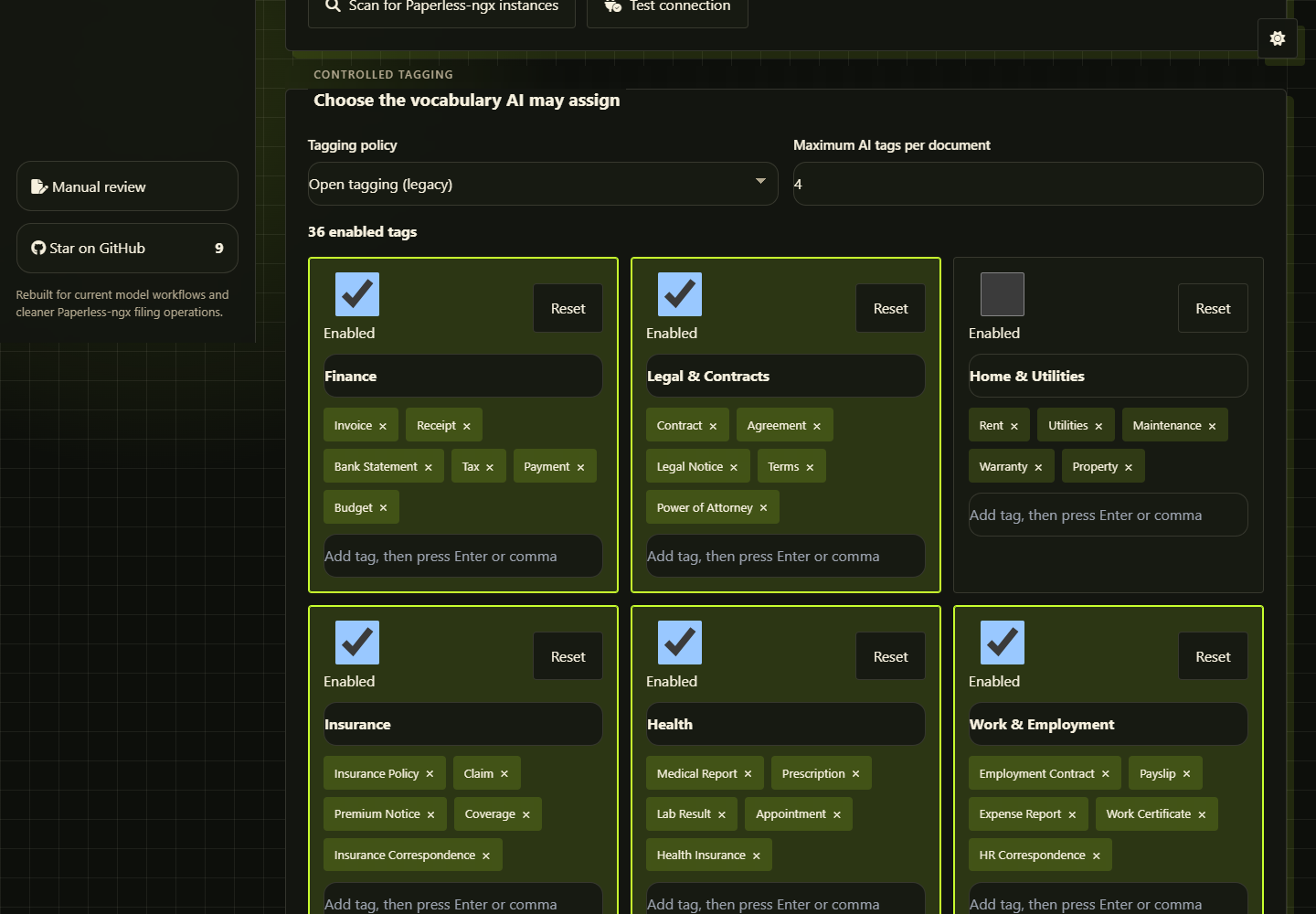
Generic category tags are shown in this capture. No document contents, names, credentials, account identifiers, or private endpoints are visible.
Review-first filing
In Review first mode, durable suggestions wait for approval. Inspect the metadata diff, apply it, reject it, or leave it queued. Switching to Automatic mode does not discard already queued suggestions.
In Automatic mode, Tagvico validates and writes enabled fields directly to Paperless. Both modes support titles, tags, correspondents, document types, dates, languages, custom fields, and optional owner assignment.
History, restoration, and retry control
Every processing run records status and usage. History supports manual reruns, rescan, and restoration from the first metadata snapshot captured before Tagvico changed a document. Provider failures are retried, then moved to a terminal state instead of looping forever.
OCR rescue
Documents with insufficient OCR can enter a durable rescue queue. Configure Mistral OCR, an OpenAI-compatible vision endpoint, or Ollama vision. Local PDF OCR limits rendered pages with OCR_MAX_PAGES; interrupted work returns to the pending queue after restart.
Subscription-backed model discovery
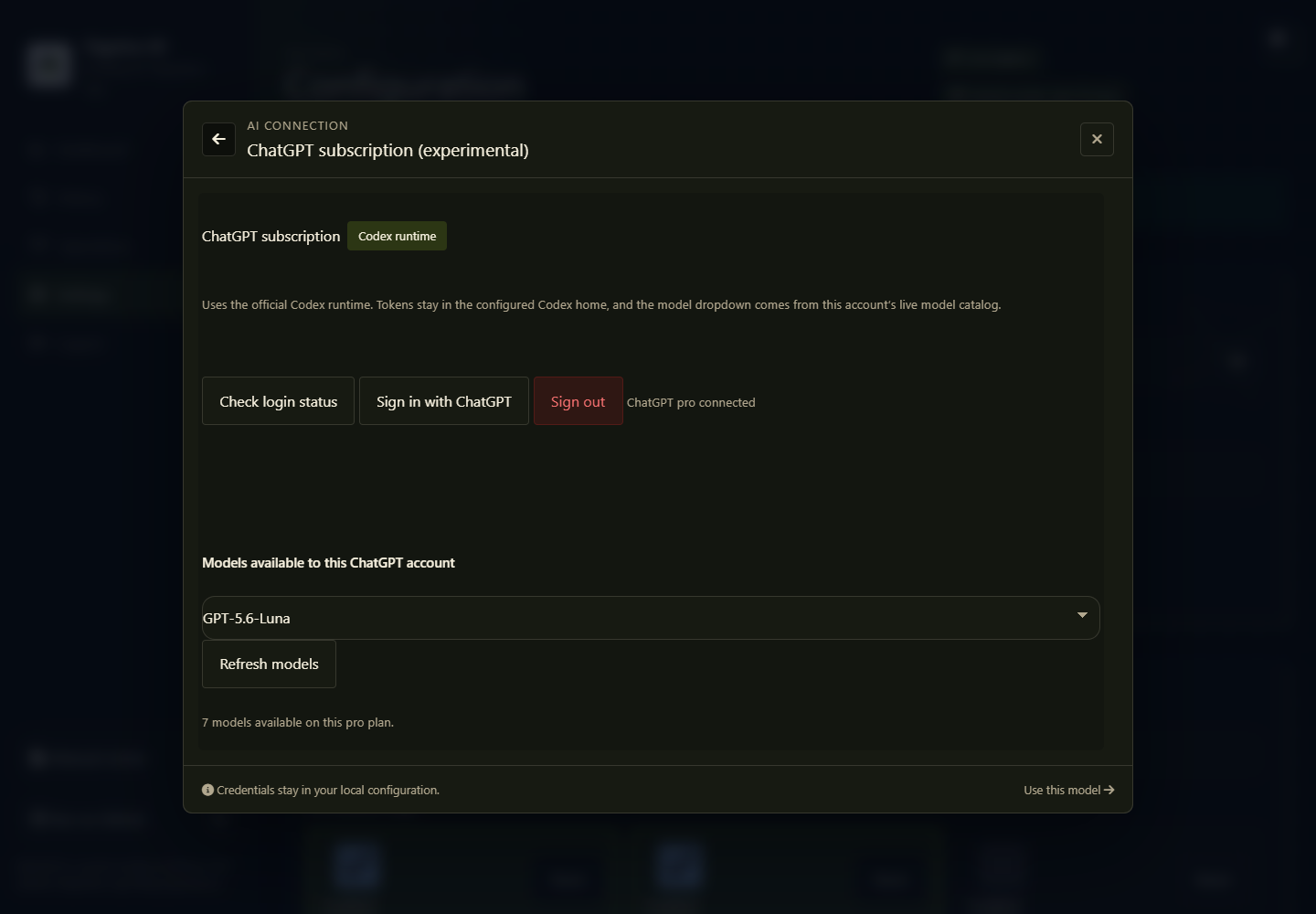
The experimental ChatGPT provider uses the official Codex runtime and shows the live model catalog returned for the signed-in account, including GPT-5.6 Luna when that account exposes it. GitHub Copilot uses the official Copilot SDK and likewise limits choices to account-visible models. Agent tools are denied for these document-extraction paths.
Optional Telegram family interface
An opt-in long-polling bot lets allowlisted people search the archive in natural language, ask follow-up questions, download cited originals, and send a PDF or photo into Paperless. Each Telegram ID maps to its own Paperless API token; unknown users and group chats are ignored, and Paperless enforces every search, download, upload, and metadata permission.
Conversation history is bounded and held in memory only. /clear removes one person's history, and a restart removes all histories. Uploads wait for the Paperless consumption task, link the existing document when Paperless reports a duplicate, and can optionally run Tagvico metadata classification. Automatic metadata for bot uploads is a separate explicit opt-in because it bypasses the web review queue.
Optional anonymous installation analytics
Installation analytics are off by default. Administrators can preview the complete outbound heartbeat in Settings before opting in. Rotating daily and monthly identifiers support active-installation counts without creating a permanent installation profile; document content, metadata, URLs, identities, keys, exact counts, and errors are never included. See Privacy and security for the complete field list and retention design.